
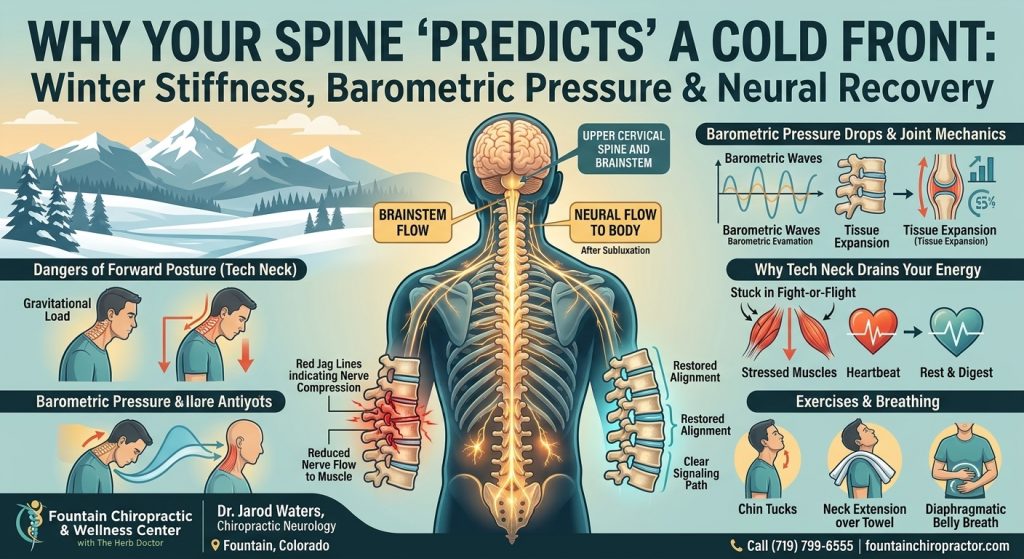
As crisp autumn days give way to freezing temperatures and winter weather fronts in Colorado, many people notice a familiar, unwelcome pattern: morning stiffness takes longer to shake off, old injuries start throbbing, and tension settles deep into the neck and shoulders.
If you have ever joked that your joints are a better meteorologist than the local forecast, your nervous system is proving you right. From a chiropractic neurology perspective, seasonal aches aren’t just in your head—they are a direct physiological response to shifting atmospheric pressure and temperature.
The Science of Weather-Related Aches
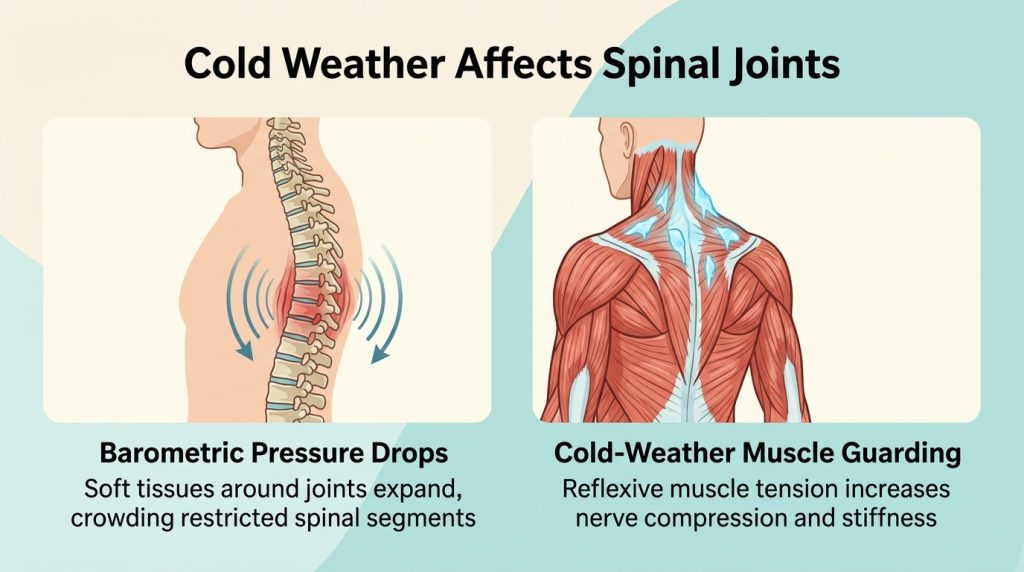
Your joints and spine are dynamic structures surrounded by fluid-filled capsules, ligaments, muscles, and dense networks of sensory nerves. When a cold front approaches, two distinct physical shifts happen simultaneously:
-
Barometric Pressure Drops: Before a storm or cold snap arrives, atmospheric pressure falls. With slightly less external air pressure pushing against your body, the soft tissues, tendons, and joint capsules around your spine expand microscopically. In a healthy, freely moving joint, you barely notice this change. In a restricted or inflamed joint, that expansion creates immediate mechanical crowding.
-
Cold-Weather Muscle Guarding: Exposure to cold air causes blood vessels to constrict and prompts your nervous system to tighten skeletal muscles to conserve heat. This “muscle guarding” increases baseline tension across your upper trapezius, neck, and lower back.
Why Subluxations Amplify Winter Pain
When a vertebra shifts out of proper alignment—a condition known as a spinal subluxation—it already compromises local joint motion and irritates adjacent nerve roots.
When you layer barometric tissue expansion and cold-weather muscle tension on top of an existing subluxation:
-
Mechanoreceptors Fire Less: Healthy joint movement sends calming signals to the brain that naturally block pain. Restricted joints stop sending these calming signals.
-
Nociceptors Fire More: Compressed, irritated nerves send amplified pain and stiffness signals up the spinal cord.
-
Nervous System Overdrive: Chronic physical tension keeps your body locked in a low-grade stress response, draining your energy and slowing recovery.
The Chiropractic Neurology Solution
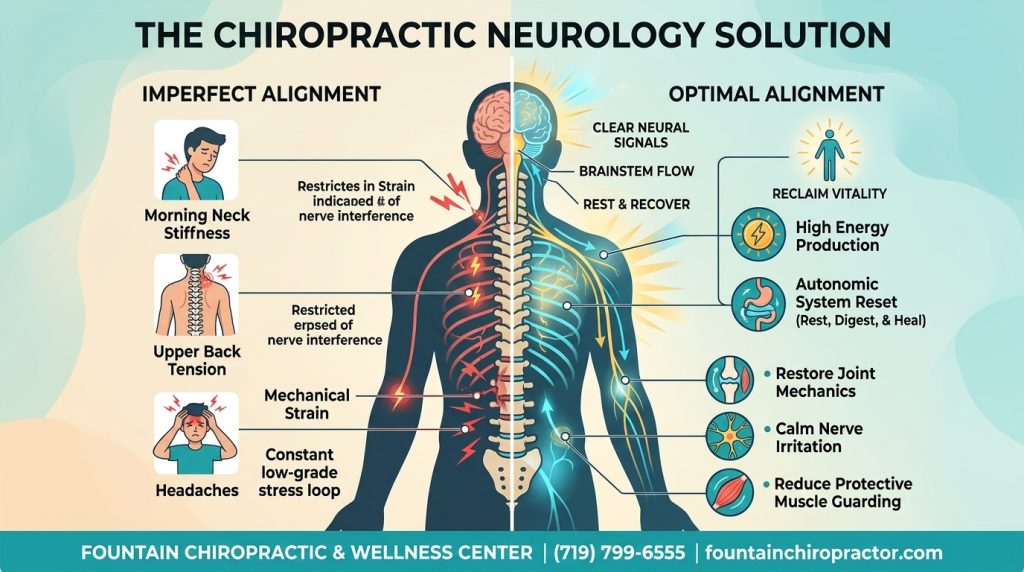
Warm baths, heating pads, and stretches offer temporary comfort, but they cannot restore motion to a locked spinal joint or clear nerve interference.
Dr. Jarod Waters uses targeted neurological and structural assessments to identify exactly where restricted spinal mechanics are amplifying your sensitivity to weather changes. Through precise, gentle chiropractic adjustments, care helps:
-
Restore Joint Mechanics: Re-establishes normal movement in stiff cervical, thoracic, and lumbar segments so tissue expansion no longer triggers pain.
-
Calm Nerve Irritation: Removes mechanical pressure from nerve roots and reactivates calming mechanoreceptor signaling to the brain.
-
Reduce Protective Muscle Guarding: Allows tight neck and back muscles to relax naturally, improving circulation and warmth throughout the tissues.
Stay Mobile and Pain-Free All Winter Long
Don’t spend the next several months bracing against the cold and accepting stiffness as your “new normal.” Keeping your spine aligned ensures your nervous system can adapt smoothly to whatever weather rolls across the Front Range.
📞 Call Fountain Chiropractic & Wellness Center: (719) 799-6555
🌐 Schedule your comprehensive assessment: fountainchiropractor.com